Maps provide robots with crucial environmental knowledge, thereby enabling them to perform interactive tasks effectively. Easily accessing accurate abstract-to-detailed geometric and semantic concepts from maps is crucial for robots to make informed and efficient decisions.
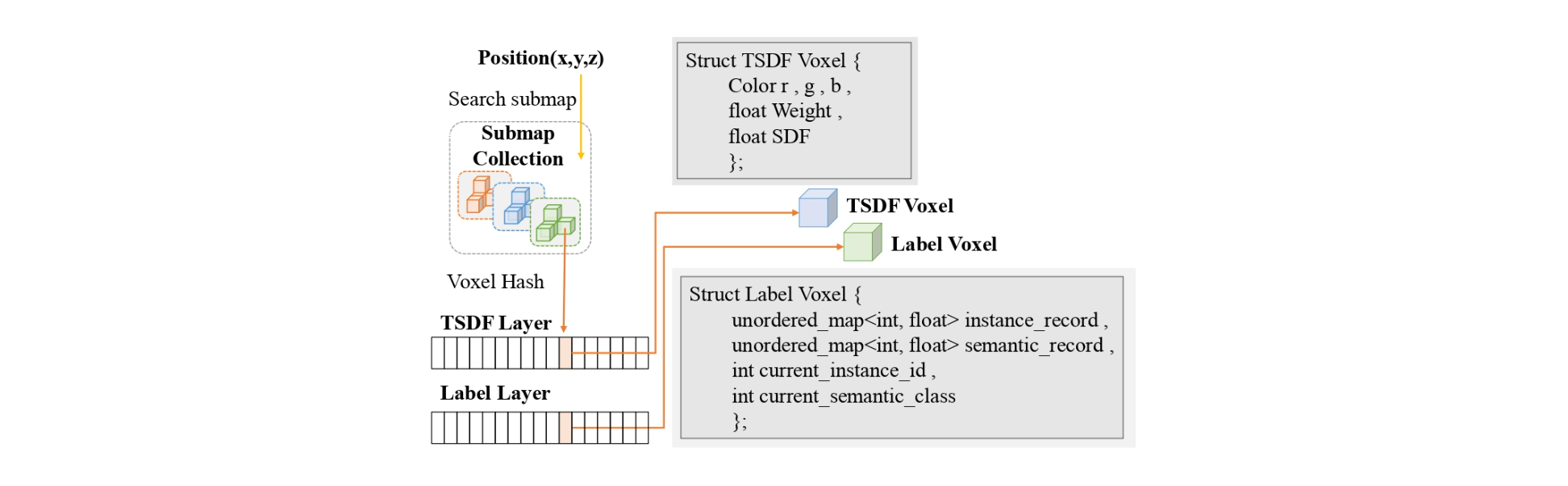
We propose DHP-Mapping, a dense mapping system that represents the environment as a collection of TSDF submaps, with each submap representing a unique object. The map structure enables hierarchical modeling. It stores the voxel-level geometry and label information into the TSDF and label layer of each submap and maintains the instance-level information via the submap collection.
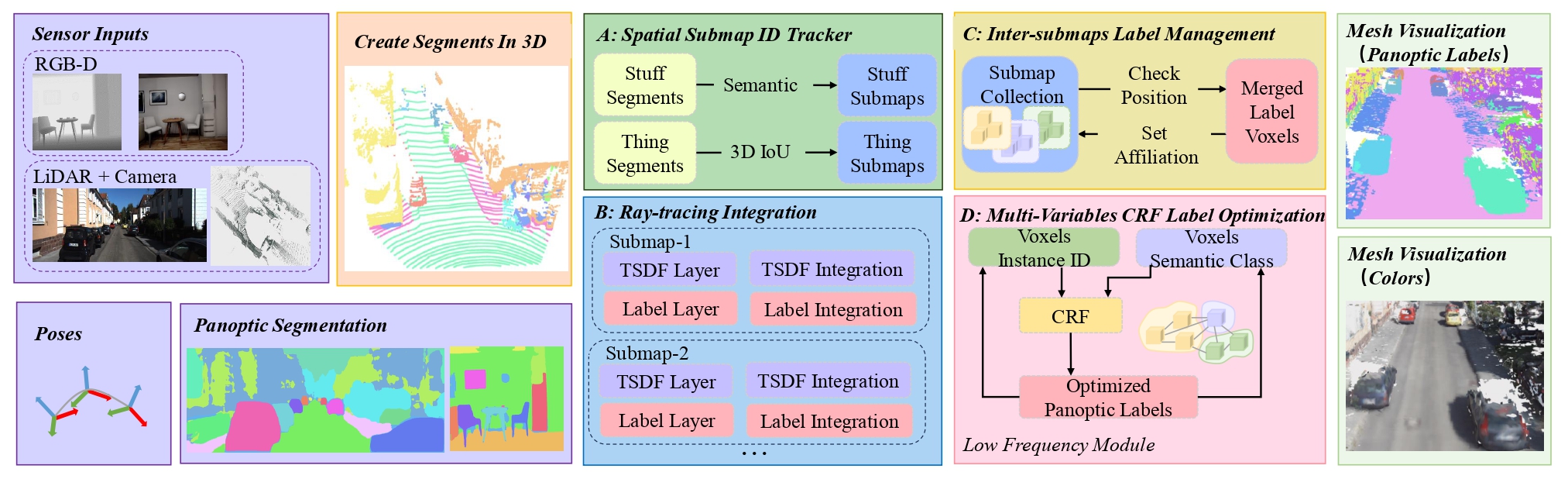
Our system converts sensor data into point segments. (A) A data-association process assigns each segment a submap ID. (B) Segment information is integrated into the assigned submap's TSDF and label layers through ray-tracing. Two modules are proposed to enhance mapping quality. (C) Fusing information among voxels sharing identical spatial information to avoid submap overlapping. (D) A CRF algorithm encourages label consistency among voxels exhibiting similar color and nearby position.
Qualitative results
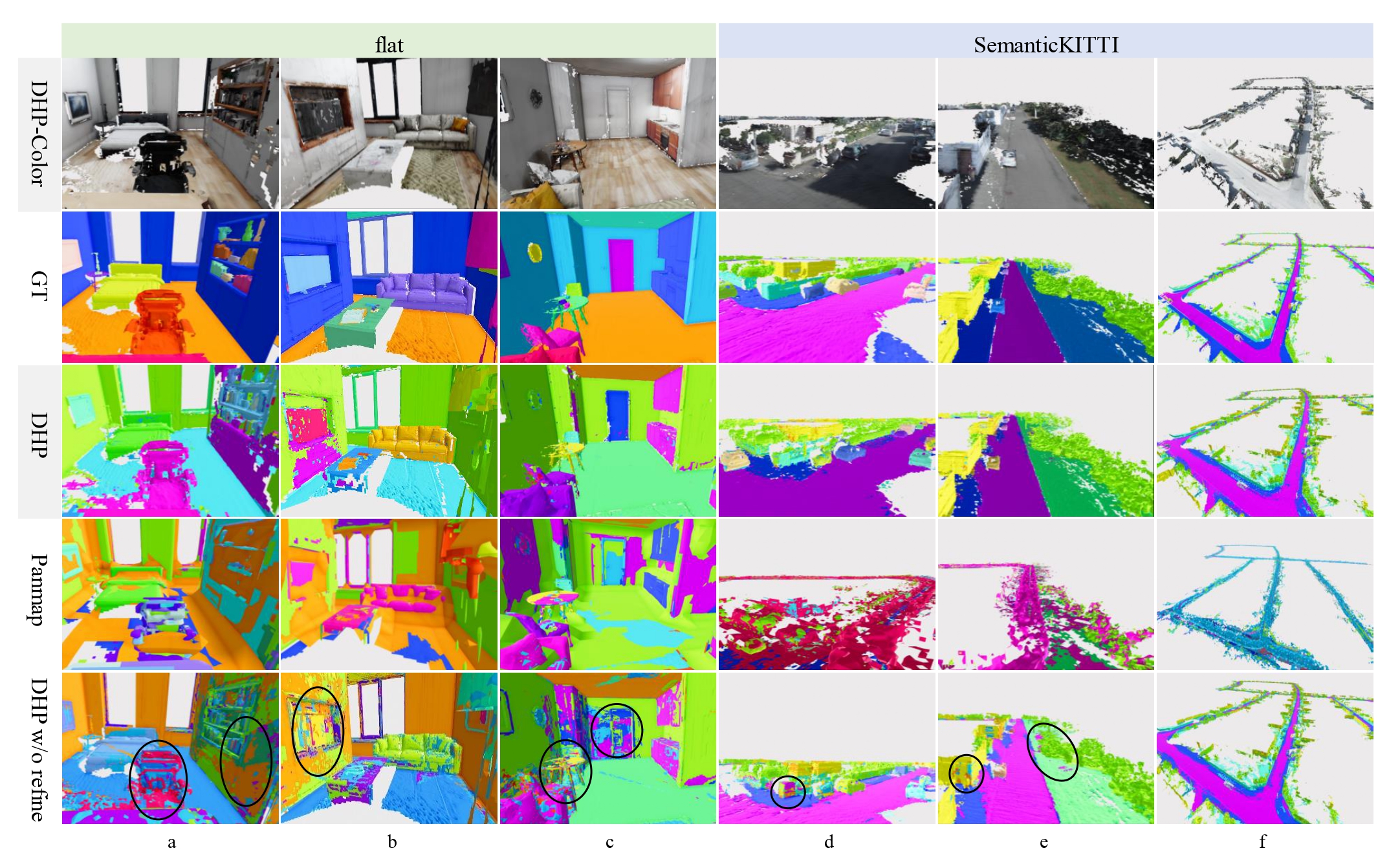
Experiments on indoor simulation (flat) and outdoor real-world data (SemanticKITTI). DHP-Mapping categorizes semantic classes and tracks object IDs more accurately, producing denser, higher-precision maps than prior work.
Quantitative results
Higher accuracy across panoptic, semantic, instance and geometry metrics on Semantic-KITTI and flat. Bold = best, underline = 2nd-best.
| Dataset | Method | PQ↑ | RQ↑ | SQ↑ | mIoU↑ | Acc.↑ | mAP.3↑ | mAP.4↑ | mAP.5↑ |
|---|---|---|---|---|---|---|---|---|---|
| Semantic-KITTI | Panmap | 0.534 | 0.804 | 0.246 | 0.271 | 0.679 | 0.546 | 0.541 | 0.532 |
| DHP w/o refine | 0.533 | 0.678 | 0.297 | 0.240 | 0.678 | 0.765 | 0.761 | 0.752 | |
| DHP | 0.568 | 0.701 | 0.340 | 0.263 | 0.713 | 0.769 | 0.765 | 0.758 | |
| flat | Panmap | 0.436 | 0.506 | 0.274 | 0.378 | 0.659 | 0.512 | 0.512 | 0.464 |
| DHP w/o refine | 0.660 | 0.660 | 0.357 | 0.382 | 0.631 | 0.690 | 0.667 | 0.667 | |
| DHP | 0.708 | 0.787 | 0.702 | 0.629 | 0.854 | 0.690 | 0.690 | 0.690 |
| Dataset | Method | mIoU↑ | Acc.↑ |
|---|---|---|---|
| S-KITTI | Kimera | 0.338 | 0.770 |
| DHP | 0.263 | 0.713 | |
| flat | Kimera | 0.670 | 0.852 |
| DHP | 0.629 | 0.854 |
| Dataset | Method | Acc.↓ | Comp.↓ | C-L1↓ | F-Score↑ |
|---|---|---|---|---|---|
| S-KITTI | Kimera | 0.0430 | 0.1871 | 0.1151 | 55.54 |
| Panmap | 0.0688 | 0.3119 | 0.1904 | 9.16 | |
| DHP | 0.0506 | 0.0584 | 0.0549 | 56.34 | |
| flat | Kimera | 0.0076 | 0.0648 | 0.0362 | 89.99 |
| Panmap | 0.0086 | 0.0763 | 0.0424 | 88.11 | |
| DHP | 0.0073 | 0.0658 | 0.0365 | 89.75 |
Conclusion
We design a dense volumetric mapping system that uses multiple TSDF submaps and panoptic labels to represent the scene hierarchically and holistically, maintaining both voxel-level and submap-level metric and label information. The inter-submap label management module ensures disjoint spatial information per submap, while the label refinement module improves panoptic-label accuracy by exploiting object cohesion and whole-scene context. This hierarchical TSDF-submaps-with-panoptic-labels structure enables high-level interactive tasks and dynamic-environment modeling. In future work, more abstract representations — topological connections between entities and language-based expressions beyond metric and symbolic representations — can be built on top of this structure.
BibTeX
@misc{hu2024dhpmapping,
  title         = {DHP-Mapping: A Dense Panoptic Mapping System with Hierarchical
                   World Representation and Label Optimization Techniques},
  author        = {Tianshuai Hu and Jianhao Jiao and Yucheng Xu and Hongji Liu
                   and Sheng Wang and Ming Liu},
  year          = {2024},
  eprint        = {2403.16880},
  archivePrefix = {arXiv},
  primaryClass  = {cs.RO}
}