NavThinker — Action-Conditioned World Models for Social Navigation
IROS 2026 · Social Navigation

NavThinker

Action-Conditioned World Models for Coupled Prediction
and Planning in Social Navigation
Tianshuai Hu1, Zeying Gong2, Lingdong Kong3, XiaoDong Mei1, Yiyi Ding2, Qi Zeng2, Ao Liang4, Rong Li2, Yangyi Zhong2, Junwei Liang1,2*
1 HKUST  ·  2 HKUST (Guangzhou)  ·  3 NUS  ·  4 UCAS   * Corresponding author
arXiv PDF Video Code
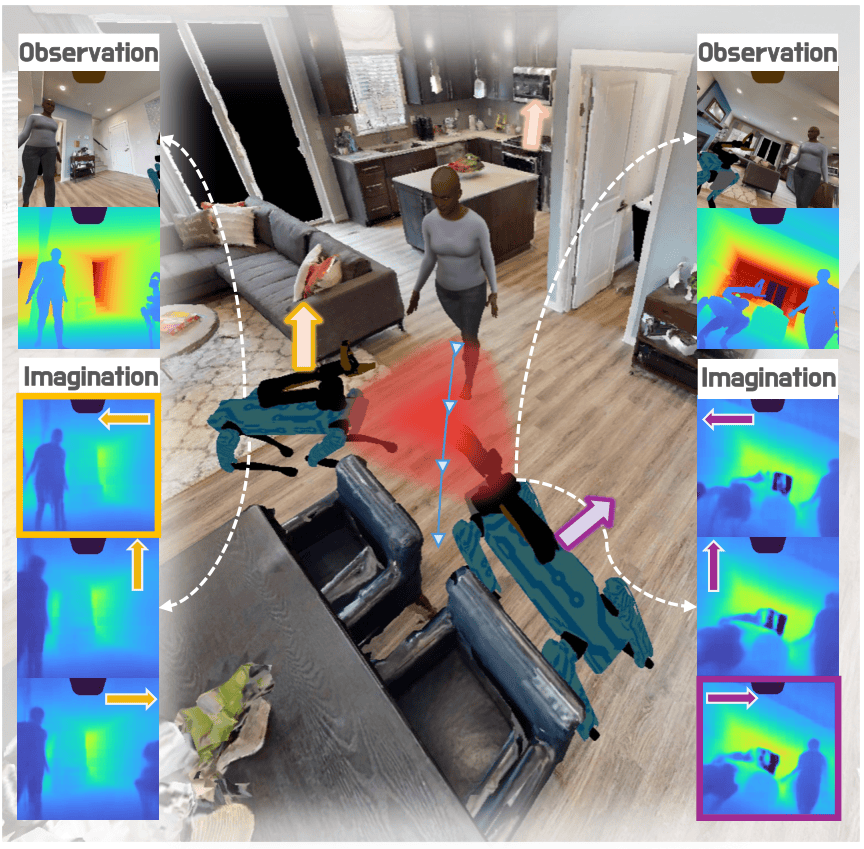
NavThinker: future-aware social navigation teaser
Future-aware social navigation. Red regions mark interaction zones. Top: egocentric depth. Bottom: the world model imagines action-conditioned futures — letting the robot anticipate conflicts and choose socially compliant actions.

Abstract

Social navigation requires robots to act safely in dynamic human environments. Effective behavior demands thinking ahead — reasoning about how the scene and pedestrians evolve under different robot actions rather than reacting to current observations alone, a coupled prediction-planning challenge. We propose NavThinker, a future-aware framework that couples an action-conditioned world model with on-policy reinforcement learning. The world model operates in Depth Anything V2 patch-feature space and autoregressively predicts future scene geometry and human motion; multi-head decoders produce future depth maps and human trajectories. We train the policy with DD-PPO while injecting think-ahead signals via action-conditioned future features and social reward shaping. Experiments on Social-HM3D show state-of-the-art success, with zero-shot transfer to Social-MP3D and real-world deployment on a Unitree Go2.

The Challenge
Robot actions and human motion mutually influence each other. Reacting to current observations alone is unsafe — planning must reason about how the scene will evolve.
The Idea
Imagine, then act. A world model rolls out action-conditioned futures, and the policy plans against them — coupling prediction and planning in one loop.

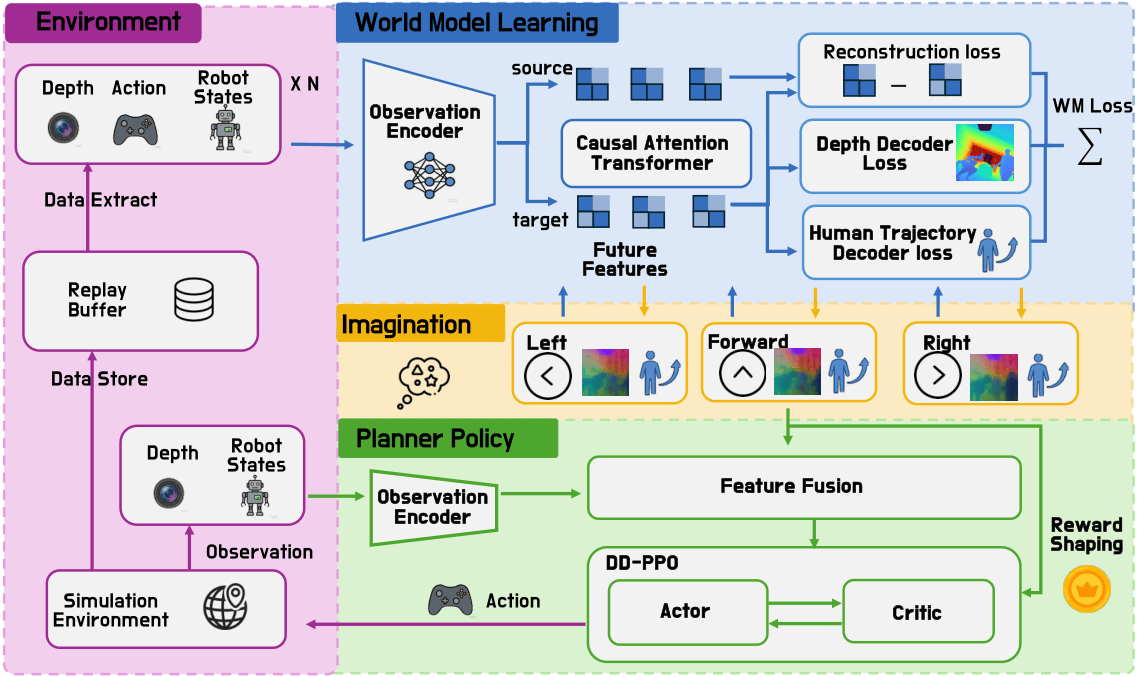
Framework overview

A world model that learns action-conditioned scene dynamics, and an imagination-augmented DD-PPO planner.
Overview of the NavThinker framework
1
World Model Learning
A frozen DA-V2 ViT encodes depth into patch embeddings; a causal Transformer autoregressively predicts future latents. Depth and human-trajectory decoders, with a latent-consistency loss, anchor the representation to geometry and motion.
2
Policy Learning
The imagination module queries the world model under each candidate action; fused future features feed a DD-PPO actor-critic. Predicted human trajectories provide reward shaping — an imagine-then-act loop.

Results

Single-robot navigation on Social-HM3D and zero-shot transfer to Social-MP3D. SR / SPL ↑, PSC (social compliance) ↑, H-Coll ↓ — best, 2nd-best.

Method Social-HM3D Social-MP3D (zero-shot)
SR↑ SPL↑ PSC↑ H-Coll↓ SR↑ SPL↑ PSC↑ H-Coll↓
{{ r.m }} {{ r.a }} {{ r.b }} {{ r.c }} {{ r.d }} {{ r.e }} {{ r.f }} {{ r.g }} {{ r.h }}

Multi-Robot Social Navigation

On Social-HM3D — multiple robots reach individual goals without communication. Team-level T-SR / T-SPL ↑.

Method SR↑ SPL↑ PSC↑ H-Coll↓ T-SR↑ T-SPL↑
{{ r.m }} {{ r.a }} {{ r.b }} {{ r.c }} {{ r.d }} {{ r.e }} {{ r.f }}
59.5
Social-HM3D SR — SOTA
Zero-shot
Transfer to Social-MP3D
Go2
Real-world Unitree deployment

Video

BibTeX

@article{hu2026navthinker,
  title   = {NavThinker: Action-Conditioned World Models for Coupled
             Prediction and Planning in Social Navigation},
  author  = {Hu, Tianshuai and Gong, Zeying and Kong, Lingdong and Mei, XiaoDong
             and Ding, Yiyi and Zeng, Qi and Liang, Ao and Li, Rong
             and Zhong, Yangyi and Liang, Junwei},
  journal = {arXiv preprint arXiv:2603.15359},
  year    = {2026}
}